Matrix Code: Crack the Hidden Cell by Reading Rows and Columns Together
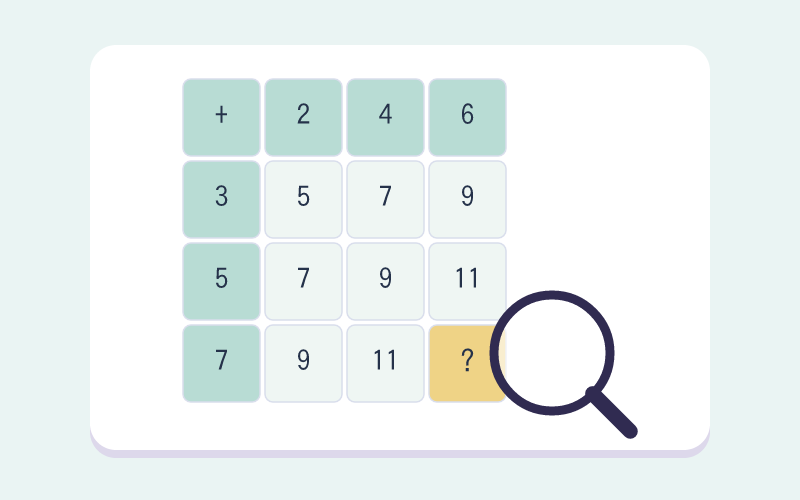
Trace your eyes across each row and down each column of an addition matrix, then decide how two values combine into a code cell. It trains students to hold two directions of information at once and reason toward the missing entry.
One Cell, Two Directions: The Answer Lives Where a Row Meets a Column
Most Grade 4-5 solvers treat every square as a standalone arithmetic problem and add the first two numbers they spot. The trouble is that a code cell is pinned by its row value and its column value together, so a single-direction glance yields a confident wrong answer. Matrix Code makes the eye's path visible: the row clue and column clue light up together, and the missing cell sits exactly at their intersection. Once students trace one row, then one column, and watch the two clues converge on the grid, the rule stops being abstract. They begin verifying each guess against a second clue before locking it in.
From Addition Facts to Two-Way Table Reasoning (Grades 4-5)
By fourth grade students already own basic addition facts, and Matrix Code repurposes that fluency into structured pattern work under CCSS 4.OA.C.5, where learners generate and analyze a rule. Reading relationships across a two-way table is the exact habit that carries into CCSS 5.OA.B.3, where paired numerical patterns and coordinate thinking begin. The game links arithmetic they already know to the table and function reasoning coming next.
Three Reasoning Skills Practiced While Cracking the Code
- Read the addition matrix as a relationship between row and column values.
- Connect row-column clues so the answer is not based on one isolated number.
- Infer the missing code cell and verify it against the same rule.
Three Moves to Crack the Matrix: Scan, Compare, Fill
- Scan the known row and column values in the addition matrix.
- Compare the row-column clues and decide how the two values create a code cell.
- Apply the same rule to the missing cell and calculate the code.
- Check the result with another row or column clue before submitting.
Five-Minute Teacher Routine: Name One Row-Column Rule
Before play, choose one row or column and ask students to explain how the values create the result. Once one relationship is clear, the final code is much easier to solve.
Matrix Code Questions Teachers Hear
Q: Why does my student get lost in the matrix?
A: The student may not be separating rows from columns. Have them trace one row, then one column, before combining the two directions.
Q: Is this an addition game or a logic game?
A: Both. Addition is the operation, but the main skill is using row-column clues to infer a missing table value.