Lowest Unique Number: Claim the Smallest Number No One Else Picks
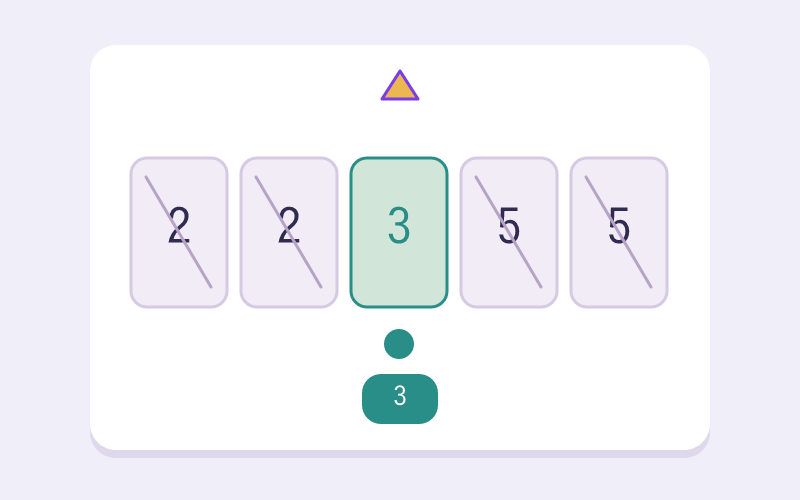
You secretly lock one number, everyone reveals at once, and any number two players share is wiped out. Winning trains you to weigh your own choice against what a whole table of rivals is likely to do.
It Looks Like a Free Grab at 1 Until You Realize Every Rival Is Lunging for the Same Small Number
Most students instantly reach for 1 because it is the lowest value, and that instinct is exactly where the round trips them up. The number is never eliminated by its size; it dies only when a second player reaches for it too, so the real task is reading the room rather than reading the digits. As you lock a hidden choice and watch the simultaneous reveal, the abstract idea of a mixed strategy becomes something you feel: pick too obviously and you collide, hedge too high and a bolder rival slips under you. Each reveal is evidence, and you fold that frequency straight into your next secret pick.
Why Grades 4-8 Both Win: From Frequency Counting to Probability Intuition
Grades 4-6 lean on skills already in place: counting how often each number appears and comparing whole numbers to find a minimum (6.SP.B.5). Grades 7-8 extend the same reveal into early probability, estimating how likely a low number is to collide and treating each round as a chance experiment (7.SP.C.6, 7.SP.C.7). That bridge from frequency counts to informal probability models is exactly the reasoning these standards ask students to build.
Four Strategy Skills Practiced in Every Round
- Count how often each number appears and separate unique choices from repeats.
- Compare the remaining unique numbers to identify the smallest one.
- Predict which low numbers other players are most likely to choose.
- Revise the next choice after checking a prediction against the reveal.
Three Moves: Choose, Reveal, Find the Unique Minimum
- Choose one whole number from 1 to 20 and lock it before anyone else can see it.
- Reveal every choice together and eliminate each number chosen two or more times.
- Find the smallest remaining unique number. That player scores one point; nobody scores when every number is repeated.
Five-Minute Teacher Routine: Predict, Reveal, Explain
Before each reveal, ask which number students expect to be repeated most often. Afterward, ask why a lower number failed and whether they would move higher next round. Three rounds create a complete prediction, evidence, and revision cycle.
Lowest Unique Number Questions
Q: Is 1 always the best choice?
A: No. It is the smallest number, but it is eliminated whenever two players choose it. The best decision depends on what everyone else may do.
Q: What happens when two players choose the same higher number?
A: Every repeated number is eliminated, regardless of size. A number must appear exactly once to remain eligible.
Q: Can a round finish without a winner?
A: Yes. If every choice is repeated, no unique number remains and nobody scores that round.