Loop Logic: Draw One Unbroken Loop From Edge Clues
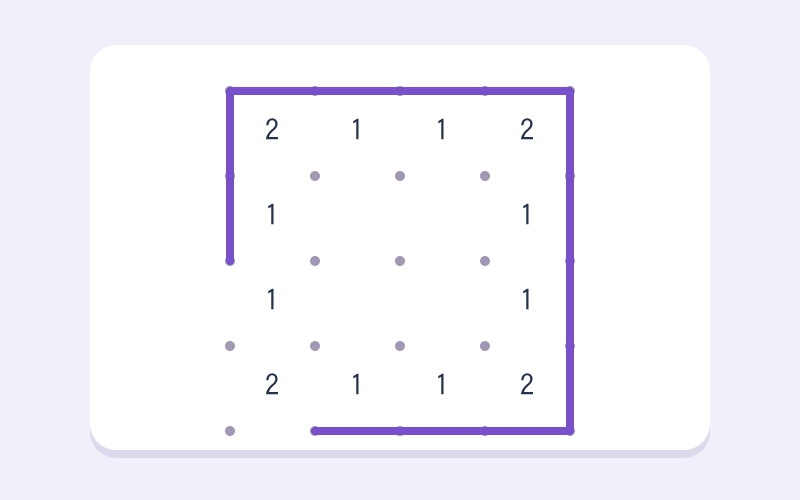
Click the segments between cells to add or erase edges, cycling each side on and off. Every clue counts the edges around one cell, so you reason from local constraints toward a single global loop.
Every Clue Can Be Right and the Loop Still Wrong: The Single-Loop Trap
Students usually get each numbered cell to show the right count and assume the puzzle is finished. But separate mini-loops can each honor their clues while leaving two or three disconnected circuits on the board. Because clicking one segment toggles a shared edge between two adjacent cells, changing a count in one place quietly changes it next door, and you feel the ripple immediately. Tracing your finished line around the grid forces the real check: can you walk the entire loop without a fork or a jump? Only when a single unbranched circuit closes does every constraint truly agree.
Deductive Reasoning and Structural Thinking for Grades 4-8
This puzzle grows the deductive habits behind proof: students look for structure (MP7), test a placement, and revise when a count breaks. It links the parity and casework reasoning of upper-elementary logic to the argument-building expected in middle-school geometry and algebra, where you construct and critique a chain of steps (MP3). The repeated edge-by-edge deductions also build the eye for regularity that underlies MP8.
Learning Points
- logical elimination
- candidate tracking
- row and column constraints
- pattern validation
Steps and completion rules
- Read each clue against its four surrounding edges and start with strongly constrained cells.
- Click an edge to add or remove it, checking both neighboring cells.
- Satisfy all clue counts and trace the result to confirm one loop with no branches or separate cycles.
Teacher / Parent Note
One edge can affect two clues. Ask students to predict both counts before selecting it.