Mixture Problem: Track the Salt That Stays While the Water Changes
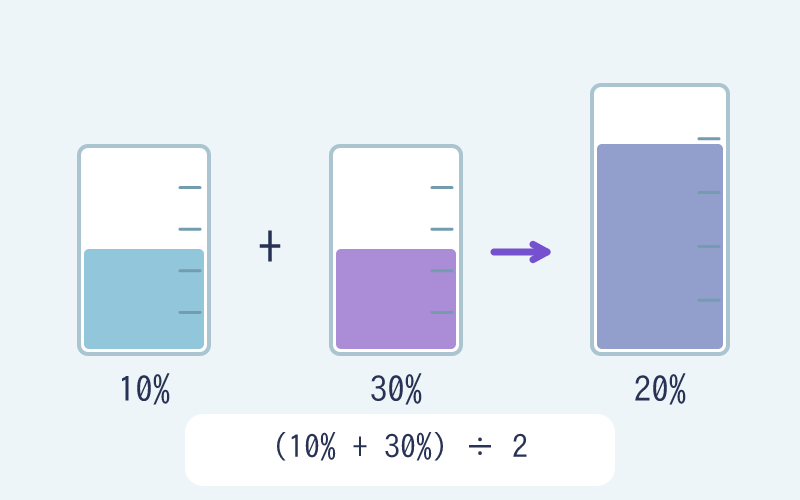
Two concentration bottles, two stacked solution bars, and a running total you build by pouring them together. Every round trains you to separate pure amount from total amount before you ever touch a percent.
Two Percentages Don't Average — Unless the Amounts Are Equal
The classic stall shows up the moment two bottles carry different percents: students grab (10% + 30%) ÷ 2 and never ask how much of each solution is in the mix. This game splits every bottle into two stacked bars — one shaded band for the salt, the rest for water — so a big-but-weak bottle visibly outweighs a small strong one. You drag or tap to pour the bars together, and the shaded salt bands add up in front of you while the totals stack separately. Because the salt band never shrinks when clear water joins, students finally see the invariant they kept ignoring, then divide combined salt by combined total to read the true mixed percent.
Beyond Grade 6 Percent Work: Reasoning Across Two Amounts at Once
Two grade-6 skills feed it: pulling a salt amount out of a percent (6.RP.A.3.C) and equivalent-ratio thinking (6.RP.A.3.A). The game then pushes past both — rather than one bottle and one percent, students carry pure amounts through two mixtures and weight each by its size. That combine-by-quantity move is the bridge to proportional percent word problems (7.RP.A.3) and to the work-rate and discount models built on the same amount-times-rate structure.
Three Percent Skills Practiced in Mixture Problems
- Separate pure amount from total amount; water has 0% concentration.
- Compute each solution bar by multiplying amount by concentration.
- Find mixed concentration by dividing total pure amount by total mixture amount.
Three Moves to Mix: Pure Amount, Total Amount, Percent
- Read each concentration bottle for total amount and percent concentration.
- Multiply amount by concentration to find the pure amount in each solution bar.
- Add pure amounts and add total amounts separately.
- Divide total pure amount by total mixture amount to choose the concentration or water amount.
Five-Minute Teacher Routine: Explain Dilution With Juice and Water
Use a simple juice-and-water example before solving. Once students understand the real-life change in concentration, the numbers become much more meaningful.
Mixture Problem Questions Teachers Hear
Q: Why do students average the two percentages?
A: Simple averaging only works when the amounts are equal. Otherwise, they must calculate pure amount first.
Q: Why does adding water keep the salt amount the same?
A: Water contributes 0% salt, so it changes total amount and concentration without changing the original salt amount.