Percent Discount: Subtract the Savings to Find the Real Sale Price
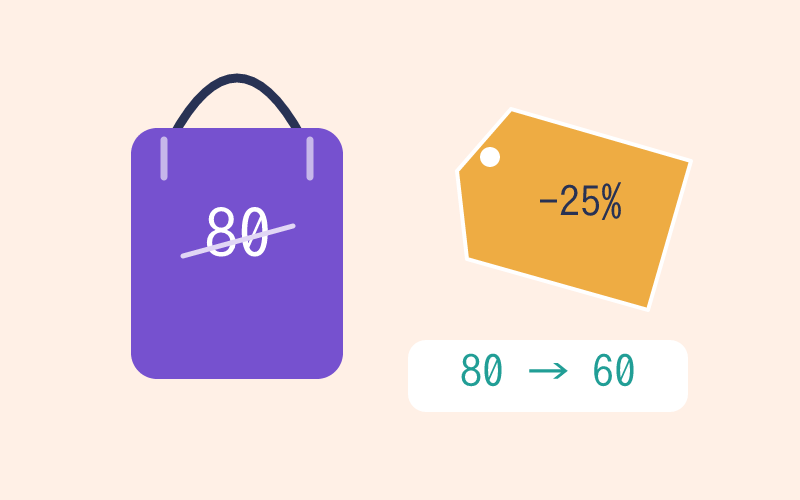
Read each price tag and discount tag, work out how much comes off, then tap the sale-price button that shows what you actually pay. It trains the two-step move that separates the amount saved from the amount owed.
Finding 25% Off Is Only Half the Problem — The Sale Price Is What's Left
An $80 tag marked 25% off pulls the hand straight to the $20 button, as if the discount itself were the price. The stall point is the second step: the sale price is the original minus that $20, not the $20 by itself. Percent Discount keeps the original price tag, the discount tag, and the sale-price choices on screen at once, so the two quantities never blur together. When you tap a wrong button, the visible gap between the discount and the remaining price makes the missing subtraction obvious. After several rounds, choosing the sale price becomes an automatic 'find it, then take it off' motion.
Where Grade 5-6 Percent Skills Meet the Store Checkout Counter
This game builds on Grade 5 fraction-and-decimal fluency and the Grade 6 idea of a percent as a rate per 100 (6.RP.A.3c), applying it to markdowns instead of bare drills. It links backward to taking a percent from a whole and forward to tax, tip, and multi-step discount problems in 7.RP.A.3. Students who master the savings-then-subtract move are ready for percent increase and proportional reasoning.
Three Percent Skills Practiced While Shopping
- Read the original price and discount percent carefully.
- Calculate the savings amount from the percent off.
- Compare sale-price choices by subtracting the savings from the original price.
Three Moves to Checkout: Read, Save, Pay
- Read the original price tag and discount tag.
- Calculate the amount saved, such as 25% of 80 equals 20.
- Subtract the savings from the original price.
- Choose the sale-price button that matches the final amount paid.
Five-Minute Teacher Routine: Ask Savings or Final Price
Before each calculation, ask whether the current step is finding the savings or the final price. That classification habit prevents most discount mistakes.
Percent Discount Questions Teachers Hear
Q: Why does my student choose the discount amount as the answer?
A: The student has found the savings but has not subtracted it from the original price. Ask for both numbers: savings and sale price.
Q: Does 40% off mean paying 40% or 60%?
A: It means the price is reduced by 40%, so the customer pays 60% of the original price. Saying that sentence prevents many reversal errors.