Percent Park Planner: Split a Park Into Percent Zones That Total 100%
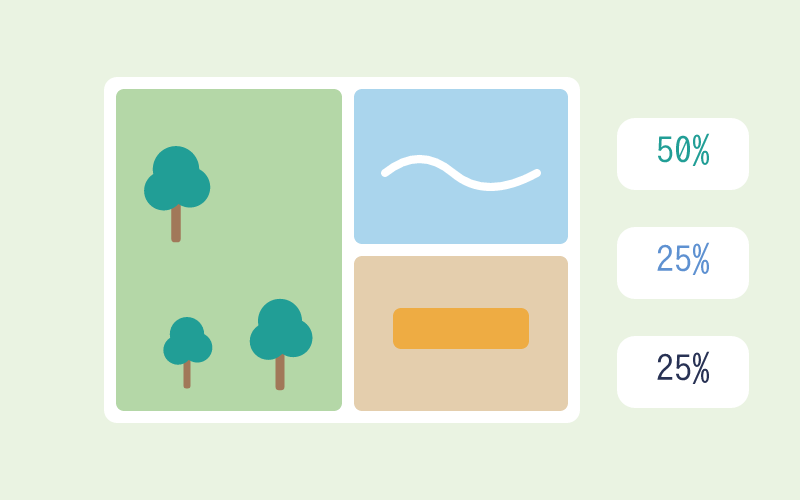
Slide two controls to hand the play, nature, and events areas their share of the park, then watch how the leftover zone shifts. It trains you to juggle several percent and budget limits at once instead of chasing one number in isolation.
Hitting 100% Is the Easy Part — the Budget and Each Zone's Range Are Where Plans Break
Most students decide a percent split is finished the moment the three zones add to 100, and they skim past the rest of the brief. Here the third zone fills in automatically as you drag, so the total is always 100 — which forces you to notice the plan can still be wrong. Every point you assign to play, nature, or events also spends $3, $1, or $2, so a legal-looking split can blow the budget. Watching the running cost and the shrinking events bar move together turns 'satisfy all the constraints' from a slogan into a picture you can read off the screen and adjust in real time.
From One Percent at a Time to Balancing Play, Nature, and Events (Grades 5–7)
It grows out of splitting a whole into percent parts (6.RP.A.3.C) and treating the park as one hundred percent shared among zones, then reaches toward the multi-step percent and budget reasoning of 7.RP.A.3. Fifth graders lean on the sliders to keep the total at 100, while sixth and seventh graders track the unit cost per point and defend why one valid plan runs cheaper than another.
Learning Points
- visual modeling
- step checking
- units and quantity
- applied reasoning
Steps and completion rules
- Read the area requirements and budget, and inspect the initially invalid plan.
- Adjust play and nature space while watching the remaining events area and total cost.
- Submit when every area constraint and the budget are satisfied. Replay to compare another target set.
Teacher / Parent Note
Compare the costs of two valid plans and explain why totaling 100% is only one of the requirements.