Target Number Dice: Combine Five Dice Into One Expression That Hits the Target
Generate five fresh values and a reachable target with a legal witness using every value.
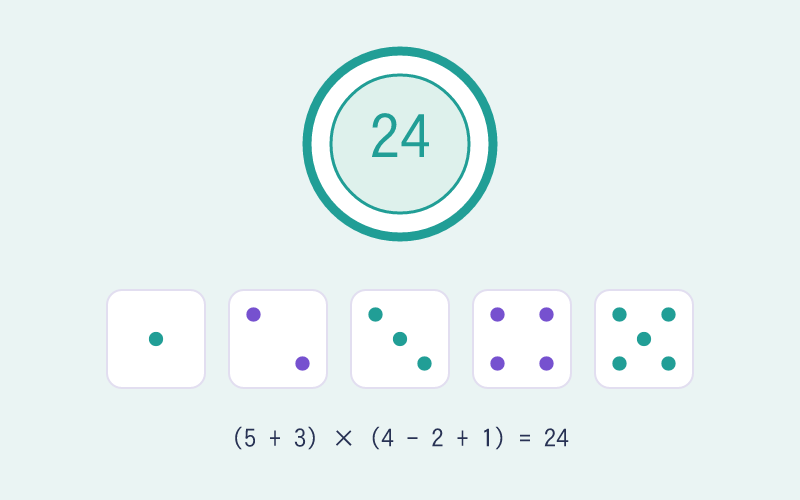
| Name | Target Number Dice |
|---|---|
| Catalog grade suggestions | Grade 4, Grade 5, Grade 6, Grade 7 |
| Actual task | Use every die exactly once with the four operations to hit the target |
| Practice objective | Practice the following task: Use every die exactly once with the four operations to hit the target |
| Optional curriculum references | CCSS.MATH.CONTENT.4.OA.A.3 (Common Core State Standards); CCSS.MATH.CONTENT.5.OA.A.1 (Common Core State Standards); CCSS.MATH.CONTENT.6.EE.A.2 (Common Core State Standards) |
Grades are catalog suggestions. Curriculum entries are references, not certification. Choose a practice length that fits your session.
One Wrong Intermediate Value Sinks the Whole Chain: Build the Middle Number First
Generate five fresh values and a reachable target with a legal witness using every value. Combine two numbers at a time and reach the target using the permitted nonnegative-integer operations.
From Fluent Four-Operation Arithmetic Toward Structured Expressions (Grades 4–7)
Fourth graders bring multi-step four-operation fluency (standard 4.OA.A.3) to the board, while fifth graders add exact-division checks and order-of-operations reasoning (5.OA.A.1). By treating each intermediate result as a reusable quantity, the puzzle previews the variable-and-expression thinking of Grade 6 (6.EE.A.2), where one value stands in for a computed part. Students who already divide and multiply fluently use those skills to compose, not merely to compute.
Core Skills Practiced in Target Number Dice
- four operations and divisibility checks
- planning expressions through intermediate values
- changing operation order and comparing solutions
Start in Three Steps
- Inspect the five dice values and target.
- Choose two values and one operation.
- Keep combining until one value remains and check the target.
Teacher and Parent Note
Before moving, ask students to name one useful intermediate value such as 1, 10, or a factor of the target. This reduces random operation trials.