Matchstick Moves: Shift One Stick to Make the Equation True
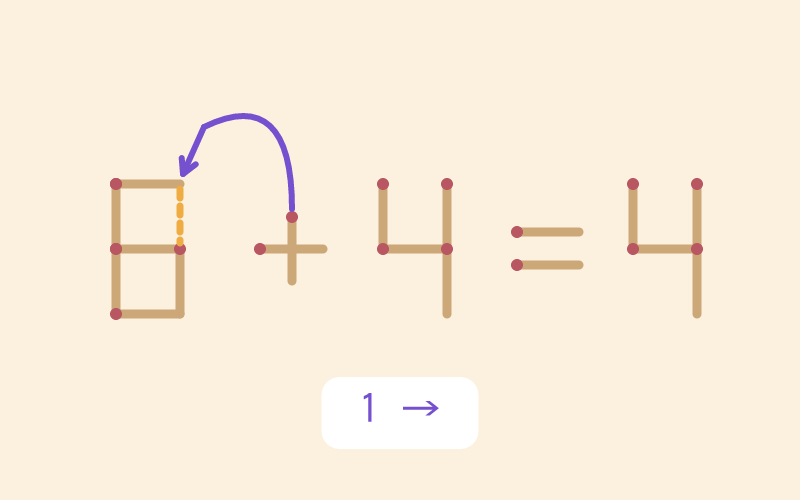
Tap a lit segment to pick up a match, then tap an empty slot to set it down—one move, no more. Each puzzle asks you to see how a single stick rewrites both a digit and the arithmetic around it.
Why a Prettier Digit Still Breaks the Sum: One Stick Changes Two Numbers
Students usually stall because they treat the puzzle as reshaping a single numeral, then discover the equation no longer balances. The seven-segment tap interaction forces one-move discipline: you can only relocate a lit stick to an empty slot, never add or delete one. Because the moved stick leaves one number and joins another, every attempt makes the trade-off visible—shrink a 6 into a 5 and the total shifts too. Submitting instantly checks the arithmetic, so a digit that looks valid but breaks the sum is rejected on the spot. That feedback trains students to plan the move around the whole equation, not one clever-looking numeral.
From Guesswork to Structured Casework (Grades 3–7)
Best suited to grades 3–7, this puzzle builds on the equal-sign reasoning of 3.OA.D.8—knowing both sides of an equation must match—and pushes toward 6.EE.B.5, where solving means finding the values that make a statement true. Along the way it strengthens the systematic counting, casework, and structural thinking (MP.7) that Olympiad and pre-algebra work depend on.
Learning Points
- spatial transformation
- multi-step planning
- working memory
- strategy review
Steps and completion rules
- Read the equation and predict which digit or symbol one moved match could change.
- Select a lit source segment and an empty destination segment.
- Submit for checking, retry an incorrect attempt, and continue after a correct solution until all three puzzles are complete.
Teacher / Parent Note
Ask for evidence of both requirements: exactly one match moved, and a true resulting equation.