Consecutive Number Path: Thread 1 to 16 Through a 4x4 Maze
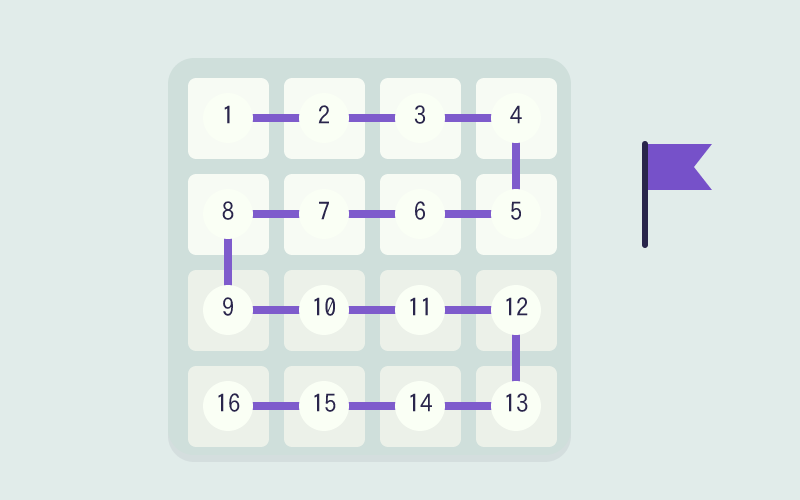
Tap an adjacent cell to drop in the next consecutive number until the chain fills the board. Each step forces you to hold the running count and the whole route in mind at once.
A Move Can Be Legal and Still Doom the Route
Students find the local rule easy: the next number just goes in a neighboring square. Where they stall is realizing a perfectly legal single step can wall off a region so a later checkpoint becomes unreachable. Because the board shows a few printed numbers, this game makes that trap visible: you can literally see where 12 or 16 sits and count backward whether your current trail leaves room to arrive there. Dragging your finger cell to cell turns 'plan ahead' from an abstract instruction into something you watch fail and undo. Tapping the previous step to retract one number lets you test a rival route instead of restarting cold.
One Grid, Two Jobs: Counting Order at Grade 2, Constraint Reasoning by Grade 6
Grade 2 players lean on fluent counting order from 1 to 16 and naming the four adjacent directions, extending number sequence work under 2.NBT.A.2. Grade 4-6 players use the printed checkpoints as constraints, reasoning backward about space the way MP1 and MP7 ask them to make sense of a problem and exploit its structure. This bridges plain sequencing toward the deliberate multi-step planning behind later logic and pre-algebra work.
Four Skills Practiced in Consecutive Number Path
- read and maintain the consecutive order from 1 through 16
- recognize orthogonal adjacency on a square grid
- work backward from later checkpoints to preserve space for the route
- undo a conflicting step and compare another legal path
Four Steps Through the 1-to-16 Number Maze
- Start from the printed 1 and find an empty cell directly above, below, left, or right.
- Select that cell to place the next consecutive number and compare the route with later checkpoints.
- If the route blocks, skips a clue, or repeats a cell, select the previous step to undo it.
- Continue until 1 through 16 cover every cell of the 4x4 board exactly once.
Teacher and Parent Note
Before each click, ask for the next value, the number of adjacent candidates, and the checkpoint that constrains the choice. At a dead end, work backward from the nearest printed number instead of naming the correct cell. After completion, compare a locally legal move with a route that remains globally finishable.
Consecutive Number Path Questions
Q: Can the path move diagonally?
A: No. Each new number must share a side with the previous one. Diagonal cells do not count as adjacent.
Q: Why are some numbers already printed?
A: They are route checkpoints. They constrain the values before and after them and reveal when an early path will run out of space.
Q: Do I have to restart after a wrong turn?
A: No. Select the previous step in the current path to remove one number, then try another adjacent cell.