20 Number Challenge: Slot Every Random Draw in Strict Ascending Order
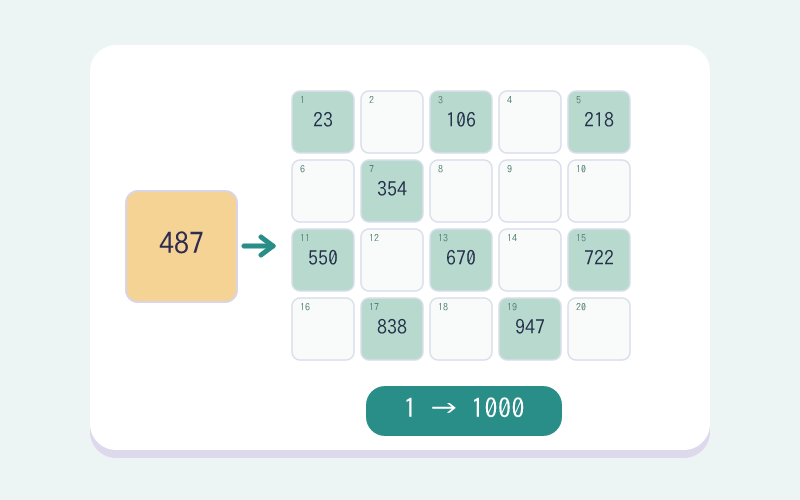
Numbers appear one at a time and each click locks a draw into a permanent slot you can never change. Every placement forces you to weigh the value in front of you against the low, middle, and high draws still hiding in the deck.
Bigger Than the Left, Smaller Than the Right — and Still Illegal
Most players assume any number that beats its left neighbor and loses to its right neighbor will drop in cleanly—then the game rejects it. The trap is the empty slots hiding between two locked values: if only three whole numbers separate 120 and 125, you cannot squeeze four future draws into that gap. Because each tap is permanent and the next integer stays hidden, you are forced to reason about how many distinct values an interval can still hold, not just about order. Watching a placement lock and shrink the runway to its right makes 'reserve space for the unknown' tangible instead of abstract—the room left for future draws visibly collapses in front of you. That visible narrowing is exactly what pushes students from comparing two numbers to planning a whole sequence.
From Three-Digit Comparison to Online Decision-Making, Grades 4-8
Dropping a three-digit draw like 640 into the right slot leans on place-value comparison of multi-digit whole numbers (4.NBT.A.2) and number-line estimation (6.NS.C.6), then stretches those skills into interval reasoning that anticipates later work with inequalities (6.EE.B.8). Grades 4-5 can practice ordering three-digit numbers with concrete feedback, while Grades 6-8 debate feasible upper and lower bounds and how many slots a range can still fill. The permanent-placement rule quietly introduces online decision-making—choosing well before all the data arrives.
Four Skills Practiced on the Ascending Track
- Compare integers from 1 to 1000, or use the classic 1–250 range.
- Estimate whether a value belongs near the low, middle, or high end of the range.
- Reserve positions for unknown future draws instead of optimizing only the current move.
- Review a blocked track and identify which early placement compressed later space.
Three Moves: Read, Place, Preserve Space
- Read the current random number and scan the values already locked on the track.
- Choose one empty position permanently. Every final value to its left must be lower and every value to its right must be higher.
- Continue until all 20 or 15 selected positions form a strict ascending order, or a draw has no legal position left.
Five-Minute Teacher Routine: Name the Interval Before Clicking
Ask students to justify a placement in one sentence, such as “168 is well above 120, but I still need room for values over 200.” After a loss, review only the earliest crowded choice and propose one better position.
Number Rank Questions
Q: Why can a number fail even when it is above the left value and below the right value?
A: Several empty positions may still sit between those values. The interval must contain enough different whole numbers to fill every remaining gap.
Q: How do the 20-slot and 15-slot modes differ?
A: The 20-slot challenge draws 20 distinct integers from 1–1000. Classic Number Rank draws 15 from 1–250. Both require permanent placements in strict ascending order.
Q: Does the daily track change?
A: Yes. Players choosing the same size receive the same sequence on the same day. Each size has its own daily track, and unlimited practice generates a fresh sequence.
Q: Can I move a number after placing it?
A: No. Permanent placement is the core challenge because it requires planning with incomplete information.