Garden Bug Hunt: Catch Every Bug That Lands in the Right Odd or Even Basket
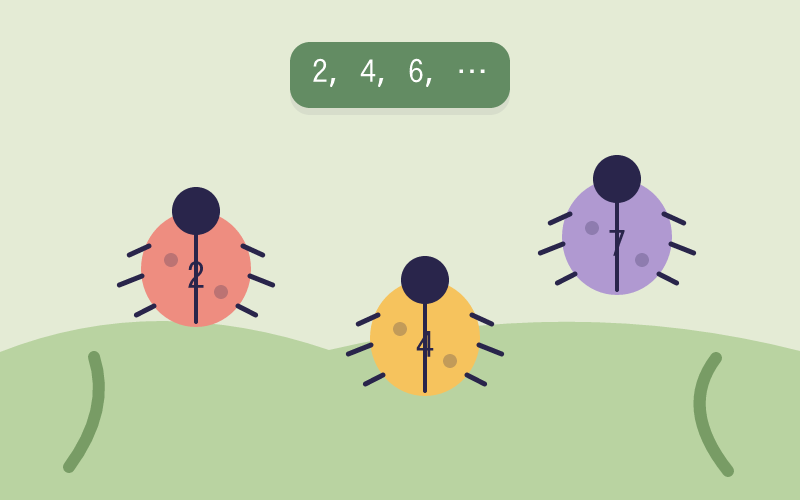
Bugs scatter across the flowerbed, each wearing a number; you tap only the ones that match the round's odd-or-even target and sweep them into the basket. Every catch forces a split-second parity check, so accuracy and focus grow together.
Kids See a 2 and Say 'Even' — Only the Last Digit Actually Decides
Where first and second graders stall is the jump from grouping objects into pairs to reading parity straight off a written number — a value like 21 gets called even because a 2 is sitting right there. Garden Bug Hunt puts every candidate number on a moving bug, so a child has to scan the whole flowerbed, lock onto the ones digit, and decide 'can this group into twos with none left over?' before the bug escapes. A wrong tap keeps the bug on screen, which quietly rewards checking the last place instead of grabbing at the first digit noticed. The pairing leaves beside each basket hold the concrete 'no leftover' model in view while the last-digit shortcut is still forming. Speed only builds once the parity rule is stable — exactly the order the concept should develop.
From Pairing Counters to a Last-Digit Rule in First and Second Grade
Once first and second graders can skip-count by twos (2.NBT.A.2) and confirm a number is even by pairing counters with none left over (2.OA.C.3), this bug hunt turns that hands-on proof into a quick last-digit judgment. That shift is the bridge kids cross before handling multiples of 2 and the grouping logic behind early multiplication. Repeated fast sorting also builds the sustained attention that later timed fact practice leans on.
Three Odd-Even Skills Practiced While Catching Garden Bugs
- Identify odd and even numbers from the last digit.
- Connect even numbers to equal pairing with no leftover.
- Filter the correct bugs without reversing the target category.
Three Moves to Catch the Bugs: Read, Sort, Basket
- Read whether the round asks for odd or even numbers.
- Check each garden bug number using the last digit or pairing idea.
- Catch the correct bugs for the basket and explain any misses.
Five-Minute Teacher Routine: Link the Basket Back to Pairing
Use counters first and make groups of two so students can see whether one is left over. That visual model helps the on-screen odd-even decisions make much more sense.
Garden Bug Hunt Questions Teachers Ask About Odd-Even Errors
Q: Why does my student call 21 even?
A: They may be noticing the 2 instead of the ones digit. Ask them to circle the last digit before deciding.
Q: Should I teach the digit rule or use counters first?
A: Use counters first when possible. The digit rule is stronger when students already understand pairing into twos.