Integer Flip: Match Each Card to Its Opposite Across Zero
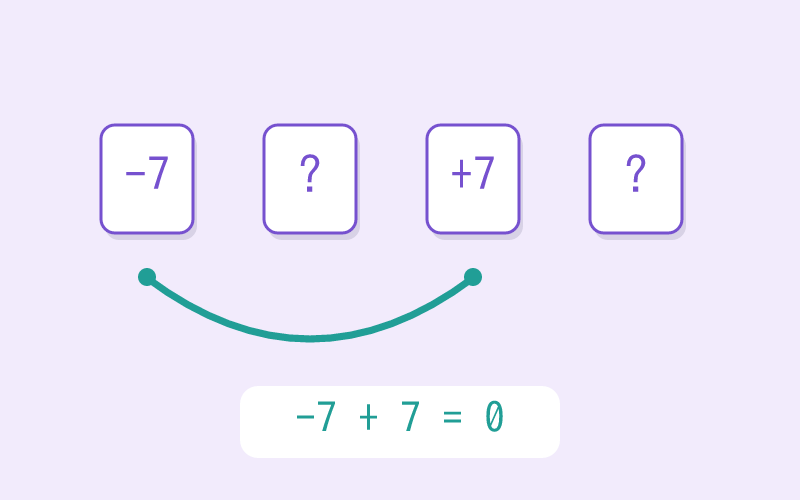
Flip face-down integer cards two at a time and pair each value with its opposite, like +7 and -7. Every match forces you to reason about distance from zero instead of trusting that two numerals simply look alike.
Same Digits Is a Clue, Not a Proof: What Makes +8 and -8 Truly a Pair
Sixth graders often flip +8, then flip -8, and declare a match just because the numeral looks the same — a habit that collapses the moment a distractor like +8 and -3 turns up. The real idea is that opposites are mirror images across zero, each an identical absolute value away but in different directions. Because the cards begin face-down, you cannot lean on the printed layout; you have to hold each card's spot on the number line in your head and picture whether the two are equally far from zero. That mental rehearsal turns a symbol-matching reflex into a distance argument. By the third round most students stop asking 'do the numbers match?' and start asking 'are they the same distance from zero on opposite sides?'
Why Sixth Graders Meet Opposites Before They Add and Subtract Integers
The game targets Grade 6, where students first place positive and negative numbers on a number line and recognize opposites (CCSS 6.NS.C.6). Pairing +a with -a and reading both as the same absolute value builds directly toward interpreting absolute value as magnitude (6.NS.C.7.C) and comparing signed numbers (6.NS.C.7). Getting fluent with opposites and absolute value here gives students the number-line picture they later reuse for integer addition and subtraction.
Three Integer Concepts Practiced While Flipping Cards
- Identify opposite integer pairs such as +a and -a.
- Understand absolute value as distance from zero, not just a symbol rule.
- Visualize zero symmetry by placing positive and negative values on a number line.
Three Moves to Match: Flip, Compare, Pair
- Flip one integer card and remember both the sign and the value.
- Flip another card and look for the same value with the opposite sign.
- Picture both cards on a number line and check whether they are equally far from zero.
- Use memory and number-line reasoning together when a match fails.
Five-Minute Teacher Routine: Draw Three Symmetric Pairs First
Mark -2 and +2, -5 and +5, and -8 and +8 on a number line before play. Seeing the symmetry makes the memory match more meaningful.
Integer Flip Questions Teachers Hear
Q: Why are +3 and -3 a pair?
A: They sit on opposite sides of zero and are both 3 units away. Opposites are about symmetry around zero, not just matching digits.
Q: Does absolute value always make a number bigger?
A: Absolute value tells distance from zero, so it is never negative. It is distance language, not a normal greater-than comparison.