Alien Addition: Shoot Down the Ship That Matches the Sum Within 20
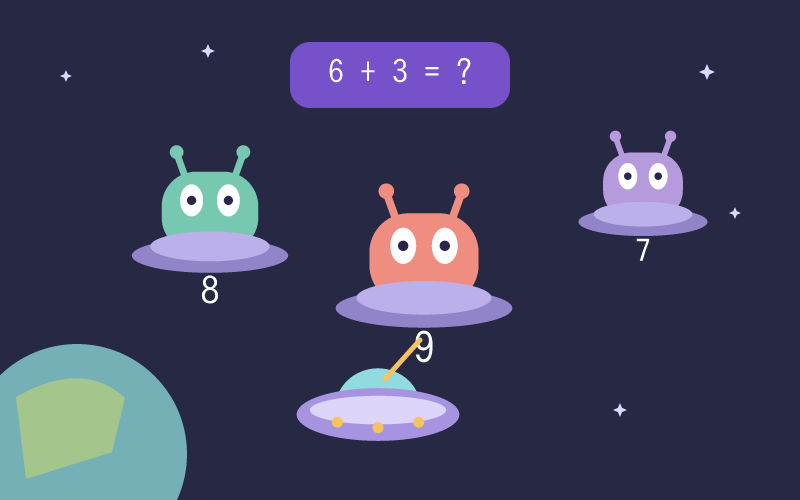
Read the equation flashing at the bottom, scan the descending ships for the number that equals the sum, and fire before it lands. Each round drills split-second fact recall under just enough pressure to make fluency stick.
The Answer Won't Sit Still: Matching a Fact to a Falling Target
Most five-to-eight-year-olds can compute 7+5 given time, but a timed quiz asks them to retrieve it in the same breath as reading it — and that gap is where they freeze. Alien Addition splits the task in two: the equation stays fixed at the bottom while three or four numbered ships drift downward, so the child must first solve, then hunt for that exact answer among moving distractors. The descending motion is the clock — miss the tap or let a ship land and a life is gone, which turns abstract 'be faster' advice into a visible, physical consequence. Because one game surfaces thirty-plus facts across five to seven rounds, the hardest combinations like 8+6 and 9+4 keep coming back until recall stops needing the pause.
Kindergarten to Grade 2: Turning Known Facts into Timed Fluency
The core target here is fluency within 20 — adding for sums within 10 without stalling, which is exactly what standard 1.OA.C.6 asks for. It leans on the earlier K.OA.A.5 habit of adding within 5, and once these sums fire off cleanly it feeds forward two ways: into subtraction within 20 (the mirror of every fact drilled here) and into the two-digit place-value fluency behind 2.NBT.B.5 plus the addition-equation work of 2.OA.B.2. That is the bridge between knowing an addition fact and owning it under a clock.
What Does Shooting Down One Alien Ship Teach? Three Reaction Skills Within 20
- Lock onto the equation and scan the descending alien ships for the matching number: compress "read, mentally solve, identify the answer" into under three seconds, the exact pattern timed math quizzes will ask for.
- Hold accuracy while the ships keep falling: train students to stay correct under playful pressure instead of guessing when time gets short — a real foundation for mental math fluency.
- Anchor number sense on the hardest combinations (7+5, 8+6, 9+4): repeated exposure under reaction pressure turns these high-frequency facts into stable conceptual understanding rather than memorized chants.
Three Steps to Becoming Earth's Math Defender: From Equation Lock to Laser Strike
- An addition fact within 20 appears at the bottom of the screen — say, 7+5=?. Three or four alien ships start descending toward Earth, each with a number above it.
- Click or tap the ship whose number matches the answer. Correct picks get hit by your laser and explode for points; a wrong tap or a ship that reaches the ground costs one life.
- The game ends when all three lives are spent. Survive all five to seven rounds and Earth is safe — restart for a higher score or check the round summary for accuracy stats.
Teacher Five-Minute Routine: Use the Alien Ships as Reaction-Practice Targets
List the three to five facts the student keeps pausing on (usually "7 plus" or "8 plus" combinations). Have them play one Alien Addition round, then re-ask those same facts orally. If the delay between question and answer is visibly shorter than before play, the under-pressure reps activated those facts and the group can move on; if the pause is still there, queue one more round or switch to Addition Puzzle for low-pressure reinforcement.
Two Questions Parents and Teachers Keep Asking About "Faster Addition Under Pressure"
Q: My child is slow on addition at home — will Alien Addition just make them more anxious?
A: The pressure comes from descending alien ships, not from a real test, and three lives give kids room to miss without losing face. That low-stakes pressure is exactly what bridges "knows it" to "answers it confidently." In one five-to-seven round game students will judge thirty-plus facts — two to three times the volume of a paper drill. Three short days of play, then a one-minute paper quiz on the same facts, usually shows a visible speed gain.
Q: How can a Grade 1 or Grade 2 teacher use this in class?
A: Use it as a five-minute reaction warm-up. Have the whole class solve six "7 plus something" or "8 plus something" facts on paper first — those are the combinations most learners pause on — then pick one student to defend Earth while the class calls out the correct answer for each ship. Re-ask the same six facts afterward; faster recall means the under-pressure reps activated those facts and the class is ready to move on.