Color Code Breaker: Deduce the Hidden Four-Color Sequence
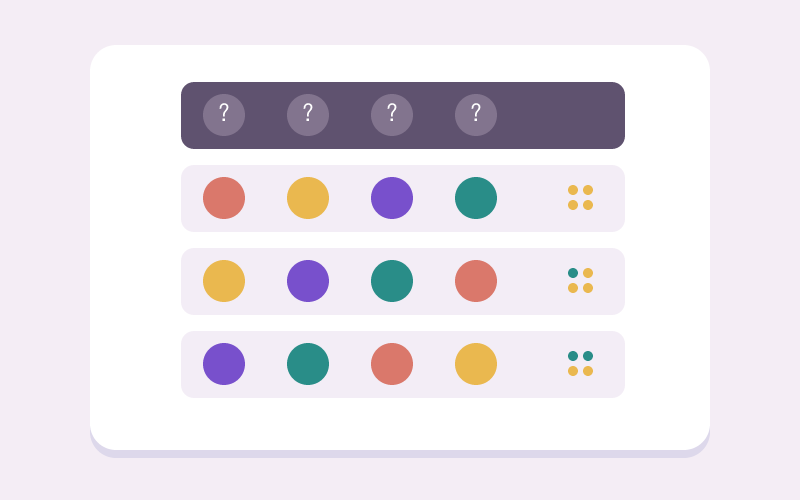
Fill a row with four distinct colors, submit it, and read how many pegs are exactly right versus merely present. Each round trains you to turn partial feedback into a logical chain that narrows six colors down to one solved code.
A ◐ Peg Says the Color Belongs but That Slot Is Wrong — Reading Misplaced Feedback
The hardest clue to read is the hollow ◐ peg: it certifies that a color belongs to the secret code yet sits in the wrong slot, so the fact you gain is negative — you now know one place that color cannot go. Say a row of red, blue, green, yellow returns one ● and two ◐: exactly one color is home, two more belong to the code but are shuffled out of place, and one color is a stranger you can drop for good. The permutation move is to hold that same four-color set and only rearrange the seats, then watch the solid ● count climb as misplaced pegs convert into exact ones. Because the eight-row history stays on screen, each ◐ becomes a standing constraint — a slot ruled out — that later rows must respect instead of a clue you forget. Solving the code is less about guessing colors than about ordering the ones you have already earned.
From Misplaced Pegs to Arrangement: What Grades 3–7 Take Into Proof
Every ◐ peg turns the puzzle into an ordering problem, and that is the reasoning CCSS.MATH.PRACTICE.MP1 and MP3 prize — persisting through partial information and building an arrangement someone else can verify slot by slot. Third and fourth graders meet it as careful sorting: which color is allowed to live in which seat. Fifth through seventh graders push the same eliminate-a-position, confirm-a-position logic toward structured argument and proof (MP2, MP7), where a claim only counts once every alternative has been ruled out. Each cracked code rehearses the move from a shuffled set of possibilities to one order you can defend.
Learning Points
- spatial transformation
- multi-step planning
- working memory
- strategy review
Steps and completion rules
- Fill a row with four distinct colors in the order you want to test.
- Submit it and read the counts of exact and misplaced color matches separately.
- Use previous feedback to revise the next guess. Solve within eight attempts; otherwise the round ends without a solved score.
Teacher / Parent Note
Justify each change: match counts do not identify which individual pegs produced the feedback.